
Empowering
Synapse empowers all players, by mapping and connecting experts, organisations, events, initiatives and resources of any given societal issue, bringing to life its whole related ecosystem.
Connected
Synapse enable societal networks to evolve from random systems to connected and actionable networks, empowering its elements and players to better shape and deliver societal impact.
Efficient
Synapse brings together relevant actors to enable a better understanding of a given societal issue and its ecosystem and allow them to shape and deliver better solutions and structures, individually or together.
How does it work
For example, Synapse for Patient Engagement offers the features below. The same features can be applied to any societal ecosystem such as maternal health, immunization, circular economy, energy etc.

Search

Ecosystem reports

Events

Organisation reports

Partnerships

Personalisation
Upcoming features

Marketplace

Disqover partnership

Global reach

Owned activities

Personalised experience
Want to know more about the tool or explore a potential collaboration?
For Patient Engagement
The current patient engagement landscape is fragmented and there is no standard general agreement on a standardised way to do patient engagement projects or to measure their impact.
Synapse has been applied to patient engagement in the “Patient Focused Medicines Development” (PFMD) initiative that aims to transform the way in which we understand, engage, and partner with patients globally in the design and development of research and medicines by focusing on unmet patient needs.
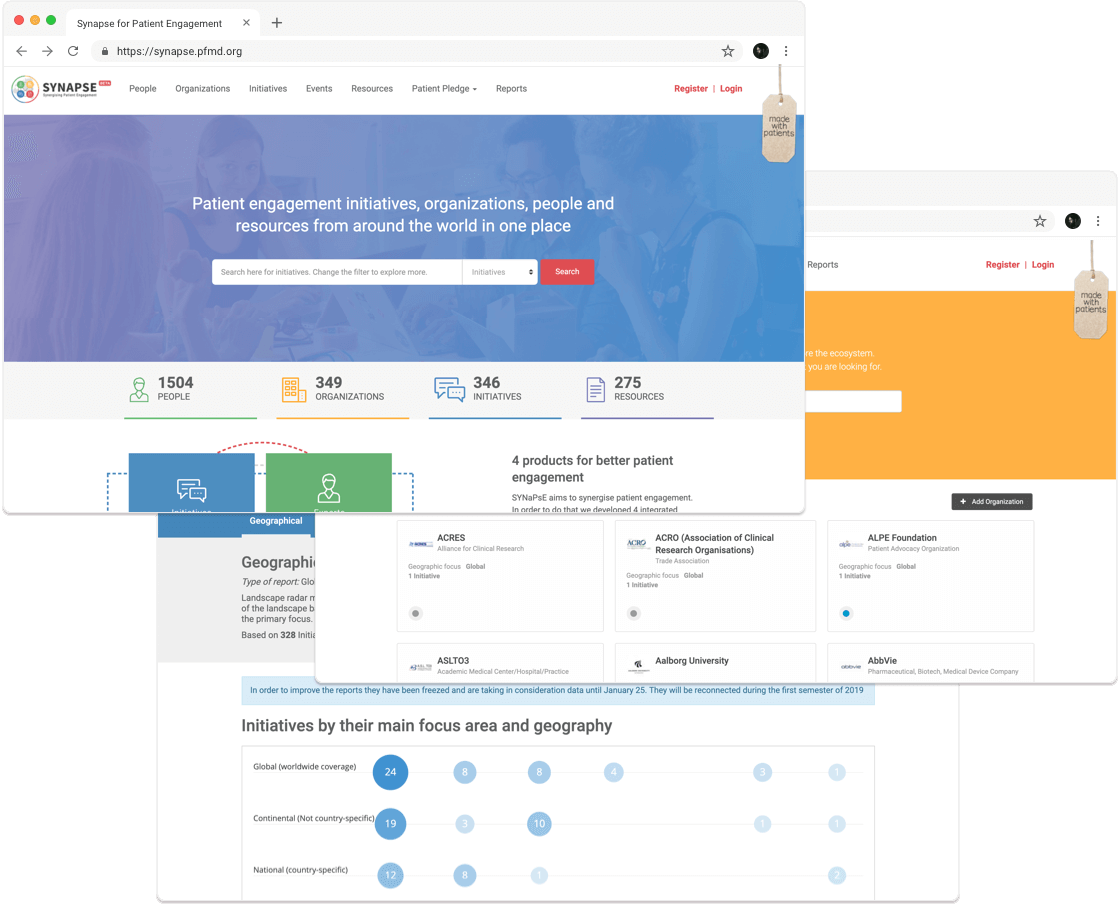
For Patient Engagement
Synapse brings together maternal health actors to map the issues, connect the partners, bring experts together, and collect resources from around the world.
In late 2018, the Synergist applied Synapse to the maternal health topic, as part of the broader Motherhood Collective Impact Programme (MCIP), a not-for-profit partnership
Partners



































Want to know more about the tool or explore a potential collaboration?
The Network Science
“Network science ¹” is the study of patterns of connection in a wide range of physical and social phenomena ². It includes theories and methods from mathematics, physics, computer science, medicine, and sociology – to examine the connections between the verticals, elements or actors. Network science can be applied to complex structures such as computer networks, biological/health/cognitive networks, and/or social networks. It is highly complex, as they include simultaneous relationships, interactions, interdependency and temporal variations. But it has great potential to link characterisations to further knowledge and understanding in science.
Over centuries, the scientific community has approached research based on the reductionism paradigm ³. This is the idea that one must first understand the smallest aspect or component of any system (including humans) to then enable understanding of the entire system, the sum of the parts. Research has not fully applied network science to advance knowledge of how (several) complex systems work. In laymen’s terms, this means we must consider the full picture, all of the dependencies both invisible and unknown.
¹ The US National Research Council defines network science as “the study of network representations of physical, biological, and social phenomena leading to predictive models of these phenomena”.
² https://www.sciencedirect.com/topics/computer-science/network-science
³ Reductionism. Wendy Doniger, ed. (1999). “Reductionism”. Merriam-Webster’s Encyclopaedia.
Contact us
Find out more about the tool and explore the possibility of a future collaboration with Synapse. Fill in the form and the right person from our team will get in contact with you for more information.